30 Proven Hook Openers for Professional LinkedIn Posts
Swipe file with 30 proven LinkedIn opening lines organized by emotion, curiosity, and credibility.
Struggling to get eyes on your posts during the first few critical seconds on LinkedIn? This swipe file delivers 30 proven hook openers organized by emotion, curiosity, and credibility to help busy creators overcome writer's block and increase early engagement. Each opener is crafted for professionals, marketers, and entrepreneurs who need fast, reliable starters that align with a polished personal brand. Use these openers alone or plug them into your LinkedIn content creation tool to generate tailored variations, tone adjustments, and complete post drafts in minutes.
Whether you manage social strategy for a startup, lead content for a consultancy, or build your own thought leadership, these hooks will save time and boost response rates. Read on for practical examples, adaptation tips, and a suggested workflow that pairs these lines with AudienceMx features like personalized post generation and automated planning. You will learn how to test openings, measure early engagement signals, and iterate for sustained growth.
Why strong openers matter for professional posts
The opening line of your LinkedIn post is the single biggest determinant of whether your audience scrolls further or keeps moving. Feed algorithms reward early engagement. If your first sentence stops a reader, you get comments, reactions, and more reach. For busy professionals, that means investing a few extra seconds in the opener yields outsized returns. Learn more in our post on Turn One Idea into Five LinkedIn Posts: Repurposing Frameworks That Scale Your Voice.
Using a reliable LinkedIn content creation tool helps you generate many opening variations fast. Rather than guessing, you can produce and compare several hooks, A-B test them across time slots, and choose the one that fits your voice and goals. The right opener also sets expectations for the rest of the post, helps you frame your point, and invites interaction without sounding pushy.
When you optimize your first line, you reduce friction for readers who scan their feed. A focused opener that signals value, emotion, curiosity, or authority increases the chance a reader will stop, read, and react. Combine these hooks with clear structure, short paragraphs, and a single call to action for maximum clarity and conversion.
How to use this swipe file with your workflow
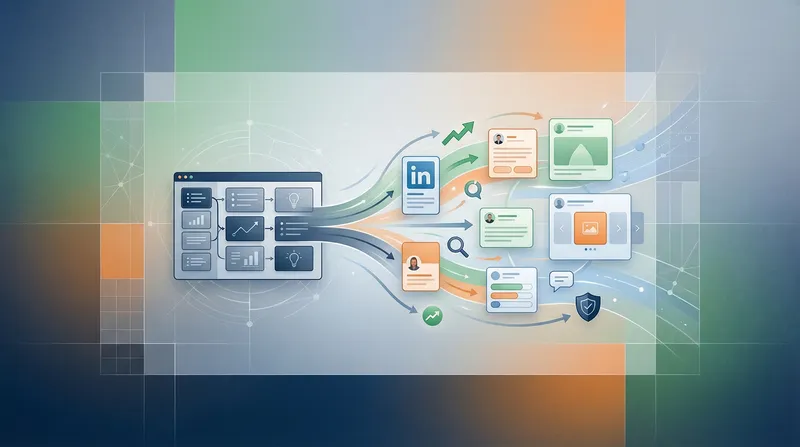
This list is intentionally practical. Each opener works as a standalone first line or as the start of a short narrative. For teams and solo creators who rely on a LinkedIn content creation tool, follow this simple workflow: Learn more in our post on How AI Raises the Value of Human Voice in Professional Content.
- Pick one opener that matches your post goal - inspire, teach, provoke, or prove.
- Plug the opener into your content idea generator to expand into three variants with different tones.
- Use personalized post generation to adapt the hook to your role, industry keywords, and audience needs.
- Schedule the top performing version into your automated content planner and monitor early engagement metrics.
If you are managing multiple accounts or producing posts under tight deadlines, these steps shrink creation time and maintain a consistent voice. A LinkedIn content creation tool speeds iteration so you can test different hooks across audiences, saving you from guesswork and improving predictability of results.
One objection I hear often is that automated tools make copy sound generic. The fix is simple. Use the tone controls, add a personal detail, or upload a quick notes file to personalize the output. Tools that support unlimited edits and one-click tone improvement let you keep speed without losing authenticity.
30 Proven Hook Openers - Organized by Emotion, Curiosity, and Credibility
Below are 30 openers grouped into three categories. Each opener is short, scannable, and designed to increase early engagement. Use them as-is or modify with a LinkedIn content creation tool to match your voice. After the lists, you will find suggestions for adapting each opener to different professional roles. Learn more in our post on Long-Term Content Strategies That Survive Algorithm Changes.
Emotion Hooks - Use to connect on a human level
- I almost quit last month because of one mistake. Follow with the lesson that matters most to your audience.
- Yesterday I received the hardest feedback of my career. Use this to share how you responded and what you learned.
- I cried in a meeting and then became a better leader. Vulnerability invites empathy and meaningful comments.
- My client told me their business was collapsing. Tell the turnaround strategy you recommended.
- I still remember the one email that changed everything. Reveal the insight and replicateable steps.
- I used to think success looked like this. Contrast past expectations with what you value now.
- This tiny habit saved my sanity during a hiring freeze. Offer a simple habit readers can adopt.
- I lost sleep over this decision for a week. Explain the risk and how you managed it.
- My team celebrated a tiny win that felt huge. Share the win and why small progress matters.
- When my mentor said no, everything changed. Describe the pivot and the outcome.
Emotion hooks are powerful for building trust and relatability. They perform well when paired with a personal anecdote and a clear takeaway. Use sparingly if your brand voice is highly formal. A LinkedIn content creation tool can help you tone an emotional opener to fit a more conservative audience without losing authenticity.

Curiosity Hooks - Use to pique attention and pull readers in
- What if everything you were taught about growth is wrong? Lead with a counterintuitive insight and back it up with data or experience.
- We tried one change for 30 days. This happened. Tease measurable results before revealing the method.
- 3 surprising things I learned from a failed launch. Use numbered lists to structure suspense and clarity.
- I built a 6 figure pipeline with only one channel. Follow with steps and caveats.
- You are probably ignoring this untapped audience. Point to a niche and explain why it matters.
- One metric most leaders misread every quarter. Explain the metric and how to reinterpret it correctly.
- We reduced churn by 40 using an odd question. Describe the question and implementation details.
- There is a simple test that predicts hiring success. Share the test criteria and validation.
- I stopped using a tool everyone loved. Here is why. Give a reasoned perspective and alternatives.
- Want to double replies from prospects? Try this single tweak. Explain the tweak and a quick experiment to run.
Curiosity hooks work best with clear evidence or a step-by-step reveal. They encourage clicks and comments because readers want to know the outcome. Use your LinkedIn content creation tool to produce variants that match your niche and audience sophistication. For example, content strategists may prefer more data-driven language while entrepreneurs may prefer practical experiments.
Credibility Hooks - Use to establish authority quickly
- I have interviewed 200 founders about scaling. Here is the pattern. Use a credible sample size and summarize the pattern succinctly.
- Our team saved a client $1.2 million in six months. Provide the approach and the exact levers used.
- As a former hiring manager for 10 years, I look for this one trait. Explain the trait and how to evaluate it in interviews.
- We increased conversion by 22 after adjusting one process. Share the process and the step-by-step change.
- Here is the exact outline I use for every keynote. Provide the outline and explain why it works.
- I taught this framework to 50 marketing teams. Results were consistent. Describe the framework and the outcome metrics.
- My first startup failed for this reason. Admit the mistake and explain the corrective action.
- I audited 30 websites and found the same mistake on all of them. Reveal the mistake and a checklist to fix it.
- Here is a template that closes deals when everything else fails. Provide the template and optional variations.
- Clients pay more when you present this one metric properly. Explain the metric and the framing technique.
Credibility hooks should be backed by specific evidence. Numbers, sample sizes, and professional context increase trust. When you integrate these openers into your content calendar with a LinkedIn content creation tool, remember to include supporting proof within the first three to five lines so the claim feels reliable rather than promotional.
Adapting each opener to your brand voice and role
Not every opening line fits every role. A content strategist may prefer data-first language while an entrepreneur may favor narrative vulnerability. Here are quick adaptation rules you can apply manually or with a LinkedIn content creation tool.
First, define your tone along three axes - formal to casual, analytical to story-driven, and bold to reserved. For each opener, select one axis to emphasize. For example, transform "I almost quit last month because of one mistake" into a more analytical opener by adding numbers and context: "One mistake nearly shut my division down - here are the three indicators we missed."
Second, add a micro-personalization detail. That could be a job title, company stage, or client outcome. Replace generic nouns with specifics that signal credibility. For instance, "my client" becomes "a Series A SaaS client" when the detail is accurate.
Third, adjust length. Shorter teams want punch, longer thought leadership pieces can start with a two-line hook. If time is limited, use your LinkedIn content creation tool to auto-generate three length variants and select the best fit for the publishing context.
Below are short examples of how to tailor one opener across three roles.
- Content Strategist: "3 surprising things I learned from running 12 content experiments across B2B SaaS."
- Marketing Director: "We tried one change for 30 days across our paid channels. These were the performance wins."
- Entrepreneur: "I built a 6 figure pipeline with only one channel during my first year. Here is how."
Testing, measuring, and iterating your openers
Testing opener performance is straightforward. Track impressions, reactions, comments within the first hour, and the share rate over 24 hours. Early engagement often predicts longer tail reach. Use those signals to decide whether to double down on a hook style or pivot.
When using a LinkedIn content creation tool, create multiple draft posts with different openers and schedule them at similar times across matched days to reduce timing bias. Compare the early engagement metrics and qualitative feedback. Note patterns such as whether emotion hooks get more comments from peers while curiosity hooks get more clicks from potential clients.
Keep a small experiment log. Document the opener, audience, posting time, media included, and the primary metric you care about. Over weeks, this builds a dataset that informs which hook types align with your goals. A content planning feature that stores past versions makes this easier because you can revisit top-performing hooks and rework them for new topics.
Remember that repeatability matters. A hook that works once may not keep working if overused. Rotate styles and refresh the wording. Use your LinkedIn content creation tool to generate fresh permutations so you maintain novelty without reinventing the wheel each time.

Common objections and quick fixes
Objection 1 - I do not have time to craft a great opener. Fix: Use a LinkedIn content creation tool to produce three high-quality hooks in under 60 seconds. Pick one, personalize with a single line, and publish. That small investment saves hours over a month.
Objection 2 - These openers feel inauthentic for my brand. Fix: Add one personal detail and use the tone control to adjust formality. Authenticity is not about dramatic honesty it is about relevance. If a hook is relevant to your audience, it will feel authentic after minor edits.
Objection 3 - I worry about sounding self-promotional. Fix: Lead with value and structure the post so the claim is supported by proof or actionable advice. Credibility hooks work best when followed by evidence rather than a call to hire you.
Objection 4 - Metrics are inconsistent. Fix: Control for variables by testing hooks at similar times and days and by keeping the post length and media consistent. Use automated planning to enforce a fair test schedule.
Practical examples and mini templates
Below are compact templates that combine a hook with structure. Use these to create a complete post quickly. Paste the hook, then follow the three-part pattern shown. You can automate this with a LinkedIn content creation tool to generate ready-to-post drafts.
- Hook - one of the openers from this list.
- Context - 1 to 2 sentences explaining the situation.
- Action - 2 to 3 bullets or steps describing what you did or recommend.
- Outcome - 1 sentence with a measurable result or insight.
- Call to action - one simple ask: comment, save, or share an experience.
Example template using a curiosity hook:
- Hook: "We tried one change for 30 days. This happened."
- Context: "Our outbound sequence swapped a long intro for a one-question opener aimed at pain points."
- Action: "1) A test cohort received the new sequence. 2) We measured replies and conversion. 3) We iterated on messaging."
- Outcome: "Replies increased 45 and pipeline velocity improved by 18."
- CTA: "Comment if you want the exact sequences we used and their timing."
Use a LinkedIn content creation tool to fill each section from bullet prompts. That reduces drafting time while preserving the narrative flow and supporting data needed for credibility.
Scaling hooks across teams and content calendars
For teams that need volume, create a rotating set of openers categorized by week. For example, week one focuses on emotion hooks, week two on curiosity, and week three on credibility. This rotation keeps content diverse while testing which category resonates most with your audience.
To operationalize at scale, store your favorite openers in the content library of your LinkedIn content creation tool. Tag each opener by topic, tone, and performance. When a team member needs a prompt, they can filter by tags and generate a polished post instantly.
Another practical approach is to pair a hook with a consistent format such as case study, how-to, or checklist. Consistency in format reduces cognitive load for your audience and improves both readability and shareability. Ultimately, the goal is to make production fast without sacrificing quality or personalization.

Final tips for busy professionals
1. Prioritize the opening line. If you only edit one element, make it the opener. It moves the needle on early engagement most consistently.
2. Keep hooks short and clear. The faster a reader understands the promise, the more likely they are to continue. Use active verbs and avoid long modifiers.
3. Use evidence quickly after a bold claim. Credibility hooks need proof in the first few sentences to avoid skepticism.
4. Rotate styles monthly to avoid audience fatigue and to collect fresh data about what works. Use a LinkedIn content creation tool to generate variations with minimal manual effort.
5. Build a swipe file from your top performers. Save the variants that get the best early engagement and reuse them as templates for new topics.
AudienceMx is designed to make these steps faster. Use Unlimited AI Writing to produce multiple hook variants at scale. Use Unlimited AI Editing to refine tone and clarity. Use the Content Ideas Generator and Personalized Post Generation to turn a single hook into multiple post formats. Lastly, rely on automated content planning to schedule fair tests so you can compare openers without the scheduling bias.
Conclusion
Openers are the small investment that yields the biggest return in professional social content. The 30 proven hook openers in this swipe file are designed to fit common needs of content strategists, marketing directors, entrepreneurs, and business owners who publish on LinkedIn. They are organized by emotion, curiosity, and credibility to make selection straightforward depending on your post goal. Emotion hooks help you form human connections and invite meaningful commentary. Curiosity hooks create suspense and clicks. Credibility hooks establish authority rapidly with evidence and professional context.
For busy creators, a LinkedIn content creation tool paired with a disciplined workflow lets you move from idea to posted draft in minutes while preserving personalization. Start by testing three hooks per topic, keep the rest of the post structure consistent, and document performance. Over several weeks you will see which hook styles reliably drive early engagement and ultimately expand reach. The best teams make this a repeatable process: capture winning openers in a content library, tag them by topic and outcome, and refresh them periodically to maintain novelty.
If you are managing content at scale, integrate these openers into a rotation plan and automate variant generation so your calendar never runs dry. Personalize each opener with a single micro-detail to maintain authenticity. When claims are bold, provide quick proof in the next lines so readers trust your message. Finally, balance experimentation with consistency. Test often, but also give top-performing styles time to compound by repeating them across related topics.
Ready to accelerate your process? Use AudienceMx to generate and refine hook variations, produce full drafts from any opener, and automate testing across your schedule. The right combination of a strong opener and systematic iteration will save you time, increase early engagement, and build a stronger personal brand on the platform.